A whole turkey is a tricky bird on any heat source. The breast finishes well before the thighs do, the skin turns leathery if the fire runs cool, and a 14-pounder leaves very little room for error when guests are already on their way. A charcoal grill adds a few more moving parts: fuel to manage, vents to adjust, and a fire that never sits perfectly still.
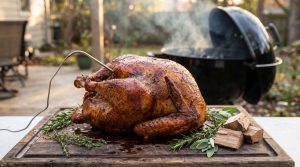
It can also produce some of the best turkey you’ll ever serve. Charcoal gives you dry, steady heat and a clean smoky edge that an oven can’t copy. Keep the bird off the coals, hold the grill in a sensible temperature range, and cook to internal temperature instead of the clock, and a regular kettle or barrel grill handles a whole turkey well. What follows covers everything from choosing the bird to carving it. It works for Thanksgiving, but it’s just as useful for Christmas, Easter, New Year’s, or any weekend when the family’s coming over and the oven is already full.
Quick answer: Set up a two-zone fire so the turkey cooks over indirect heat, hold the grill between 275°F and 325°F, add a few chunks of mild fruitwood, and cook until the thickest part of the breast and the innermost part of the thigh both read at least 165°F. A 12 to 14 pound turkey usually takes about 2½ to 3½ hours, but the thermometer makes the call.
What Makes a Charcoal-Smoked Turkey Different?
Three things set it apart from an oven turkey: the fuel, the smoke, and the way the heat arrives.
Charcoal burns hotter and drier than a gas flame or an electric element, and that dryness is good for skin. Smoke from burning wood adds flavor, and poultry soaks it up quickly, which is why restraint matters more than quantity. Then there’s indirect cooking. Instead of sitting over the coals, the turkey cooks off to the side, with the lid closed so hot air circulates around it like a convection oven with a campfire inside.
The trade-off is that you’re running the fire yourself. A thermostat won’t save you. A good thermometer, a few extra coals in reserve, and a little attention to the vents do the same job.
What You’ll Need
You don’t need a pile of gear, but a few things make a real difference.
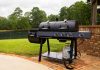
- A charcoal grill with a lid that closes fully. A 22-inch kettle can handle a turkey up to about 16 pounds. Beyond that, check how much clearance you have under the lid before you commit. Larger barrel-style grills and smokers give you more room.
- Briquettes burn more evenly and predictably than lump, which helps on a cook that runs for hours. Lump burns hotter and cleaner but varies more in size, so it takes a bit more tending. Keep a second bag on hand either way.
- Smoking wood. Chunks last longer than chips on a long cook. More on choosing them below.
- A charcoal chimney starter. It lights coals evenly without lighter fluid, and you’ll want it for refueling mid-cook. [Affiliate opportunity: charcoal chimney starter]
- A disposable aluminum drip pan. It catches drippings so they don’t flare up on the coals and gives you a base for gravy.
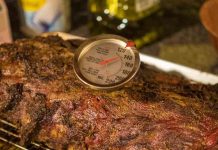
- A reliable instant-read or leave-in probe thermometer. This is the one piece of equipment worth being picky about, because the whole cook depends on it. A second thermometer that sits at grate level to track grill temperature is also worth having. [Internal link opportunity: relevant KitchenGazette meat thermometer article] [Affiliate opportunity: instant-read thermometer and dual-probe thermometer]
- Heat-resistant gloves and long tongs. You’ll be moving a hot, heavy, slippery bird, and possibly adding coals through the grill’s side openings. [Affiliate opportunity: heat-resistant grill gloves]
- A whole turkey, kosher salt, black pepper, oil or softened butter, and any aromatics you like: onion, garlic, lemon, apple, or fresh herbs.
Choosing the Right Turkey
Size comes first. For a charcoal grill, a turkey in the 10 to 14 pound range is the easiest to manage. It fits under the lid, cooks more evenly, and finishes in a reasonable window. If you’re feeding a crowd, two smaller birds will usually cook better than one very large one.
Fresh or frozen both work. Frozen turkeys are cheaper and widely available, but they need real thawing time. In the refrigerator, plan for roughly 24 hours for every 4 to 5 pounds, so a 14-pound bird needs about three days. A turkey that’s still icy in the middle will cook unevenly and can leave you with a breast that’s overdone while the inside is still catching up.
Read the label before you buy. Many supermarket turkeys are labeled “self-basting” or “basted,” which means they’ve been injected with a salt solution. Kosher turkeys are also pre-salted. Either one is already seasoned from the inside, and adding a heavy brine on top can leave you with meat that tastes like ham. If the label lists a solution or says “enhanced,” skip the brine and go light on the salt in your rub. If it says nothing but “turkey,” you’ve got a blank canvas.
If you’re thawing a frozen bird, never leave it on the counter overnight. The refrigerator is the safest method. A sealed bird in cold water, changed every 30 minutes, thaws faster, at roughly 30 minutes per pound, if you’re short on time.
Should You Brine the Turkey?
For most home cooks, a dry brine is the better choice on a charcoal grill, and here’s the reasoning.
A dry brine is just salt (plus whatever other seasoning you like) rubbed over the turkey and left to sit in the refrigerator. The salt draws out moisture, dissolves in it, and gets pulled back into the meat, which seasons it all the way through and helps it hold onto juices as it cooks. It also leaves the skin dry, which is exactly what you want for browning. A reasonable starting point is about 1 tablespoon of Diamond Crystal kosher salt per 4 pounds of turkey. If you’re using Morton kosher salt, which is denser, cut that by about a third. Rub it under and over the skin, set the turkey on a rack over a sheet pan, and leave it uncovered in the fridge for 24 to 48 hours.
A wet brine soaks the turkey in salted water, usually for 8 to 12 hours. It does add moisture, but it also waterlogs the skin, takes up a lot of refrigerator space, and requires a container big enough to hold the bird and enough ice to keep it below 40°F. If you’ve done it before and like the results, it still works. Just dry the skin very thoroughly afterward.
Skip both if your turkey is pre-brined or self-basting.
How to Prepare the Turkey
Start by taking the turkey out of its packaging and removing the neck and giblets from the cavities. Save them for stock if you like. Pat the whole bird dry with paper towels, inside and out.
If you’re dry brining, do that now and let the turkey rest uncovered in the fridge. If you’re skipping the brine, season it right before it goes on the grill with salt, pepper, and any other rub you like. Brush or rub a thin coat of oil or softened butter over the skin. A sugary rub can scorch at these temperatures, so go easy on sweet blends or add them only near the end.
Aromatics in the cavity, like quartered onion, a halved lemon, garlic cloves, and a few herb sprigs, add a little fragrance, but they don’t do much for flavor in the meat itself. Keep the cavity loosely filled so hot air can still move through. And don’t stuff the turkey with bread stuffing for the grill. It slows the cook, and it’s harder to get stuffing safely hot in the center without drying out the meat. Make it separately.
Tuck the wing tips behind the shoulders so they don’t burn, and if you like, tie the legs together loosely with kitchen twine. Let the turkey sit at room temperature for 30 to 45 minutes before it goes on the grill, so the surface isn’t ice cold.
How to Set Up a Charcoal Grill for Smoking
This is the part that decides whether your turkey comes out juicy or scorched, so it’s worth getting right.
The goal is a two-zone fire: hot coals on one or two sides of the grill, and a cooler zone in the middle or on the opposite side where the turkey sits. Heat reaches the bird through hot air circulating inside the closed lid, not by flames or glowing coals directly underneath it.
On a standard kettle, this is the setup most people find easiest:
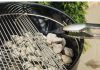
- Light about half a chimney of briquettes. When the top coals are covered with gray ash, pour them into two piles on opposite sides of the charcoal grate, or into charcoal baskets if you have them.
- Put the aluminum drip pan in the middle, between the coal piles. Adding about a cup of water keeps the drippings from burning.
- Place the cooking grate over the top. Put the turkey on it, breast up, right above the drip pan.
The bird should sit squarely over that pan, never over the coals. That’s what protects the skin from scorching and gives you the gentle, even heat that keeps the breast from drying out.
If your grill is smaller or you prefer a one-sided fire, you can bank all the coals on one side and place the pan and turkey on the other. Just remember to rotate the bird halfway through so that the legs, which cook slower, face the fire for part of the cook.
Airflow is what controls the temperature. Open the bottom vents about halfway to start, and set the top vent over the turkey about halfway too. More air means a hotter fire and more oxygen for the coals, and less air means a cooler, slower one. Closing the vents down too far can create stale, sooty smoke and can even let the fire go out, so make small adjustments and wait 10 to 15 minutes to see what they do. Keep the lid on as much as possible, because every time you lift it you lose heat and add time to the cook.
Best Temperature for Smoking Turkey on a Charcoal Grill
Aim for a steady 275°F to 325°F at the grate. Not a single number, a range, and the reason is practical. Below about 250°F, the skin tends to stay rubbery, and the turkey spends more time in the temperature range where bacteria multiply. Above about 350°F, the outside can brown too quickly before the thickest parts are done, and the smoke flavor turns harsh.
What matters more than the exact number is stability. A grill that swings between 250°F and 375°F will produce uneven results, even if the average looks right. Check your grate-level thermometer often, make small vent adjustments, and don’t panic over a 20-degree drift in either direction.
Best Wood for Smoked Turkey
Poultry is mild, so it takes on smoke quickly. Fruit and nut woods are the safest choice for beginners.
- Apple and cherry: Light and slightly sweet. Cherry also gives the skin a pleasant mahogany color.
- Pecan: Mellow and nutty, a little richer than apple.
- Maple: Gentle and a bit sweet, good for a more subtle smoke.
- Hickory and oak: Stronger, more traditional BBQ flavors. They can work on turkey, but use them sparingly or mix with a milder wood.
- Mesquite: Usually too intense for poultry on a long cook.
Use two or three fist-sized chunks for a whole turkey. You don’t need to soak them. Place them on top of the lit coals once the grill is up to temperature, and look for thin, pale blue smoke. If the smoke is thick, white, and billowing, the wood is smoldering without enough air, and that’s how you get a bitter, acrid taste. Open the vents a little and let it clean up. Most of the smoke flavor goes onto the bird in the first hour or two, so there’s no need to keep adding wood throughout the cook. [Affiliate opportunity: apple, cherry, or pecan smoking wood chunks]
How Long Does It Take to Smoke a Turkey?
Short answer: Plan on roughly 11 to 15 minutes per pound at 275°F to 325°F. A 12 to 14 pound turkey typically takes between 2½ and 3½ hours.
| Turkey weight | Estimated time at 275–325°F |
| 10–12 lb | 2 to 3 hours |
| 12–14 lb | 2½ to 3½ hours |
| 14–16 lb | 3 to 4 hours |
| 16–18 lb | 3½ to 4½ hours |
Treat these as planning estimates, not promises. Cold or windy weather, how often the lid gets opened, the grill’s size, and how steady your fire runs can all push the cook longer or shorter. The only thing that tells you the turkey is done is its internal temperature. Start checking about an hour before you expect it to finish, and build in a buffer. A finished turkey can rest, wrapped and tented, for an hour or more, but a turkey that isn’t done holds up dinner.
Step-by-Step: How to Smoke a Turkey on a Charcoal Grill
- Prep the turkey. Thaw completely, remove the giblets, pat dry, season or dry brine, and let it sit out for 30 to 45 minutes before cooking.
- Light the charcoal. Fill a chimney about halfway with briquettes and light it. Wait until the top coals are covered in gray ash, about 15 to 20 minutes.
- Build the two-zone fire. Pour the coals into two piles on opposite sides of the grate, with the drip pan in the middle. Set the cooking grate in place.
- Add the wood. Place two or three chunks on top of the coals. Close the lid and let the grill settle near 300°F, with the vents about half open.
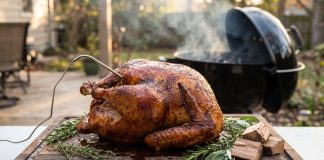
- Position the turkey. Set the bird breast up on the grate directly over the drip pan. Insert a probe thermometer into the thickest part of the breast, without touching bone, if you’re using a leave-in probe.
- Monitor the grill. Keep the lid closed and watch the temperature at the grate. Adjust the vents in small steps and give them time to work.
- Refuel as needed. Every 45 to 60 minutes, add 10 to 15 pre-lit briquettes from a chimney to keep the fire going. Don’t toss in cold coals, which can send the temperature down and make the smoke taste harsh.
- Check internal temperature. Start checking about an hour before the estimated finish. The thickest part of the breast, the innermost part of the thigh, and the thickest part of the wing should all read at least 165°F.
- Finish the skin. If the skin is pale near the end and the turkey is already at temperature, you can open the vents for a few minutes to raise the heat, but pull the turkey the moment it’s done. Don’t push the internal temperature higher to chase color. If the skin is browning too fast earlier, loosely tent the breast with foil.
- Rest the turkey. Move it to a cutting board or tray, tent it loosely with foil, and let it rest for 20 to 30 minutes.
- Carve and serve. See the carving section below.
How to Know When the Turkey Is Done
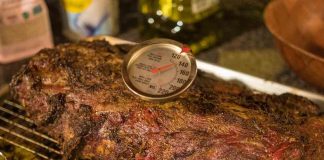
A smoked turkey is done when it reaches a safe internal temperature, not when the clock runs out and not when the skin looks right. The USDA’s safe minimum is 165°F, measured in the innermost part of the thigh, the innermost part of the wing, and the thickest part of the breast.
Use an instant-read thermometer and make sure the tip isn’t touching bone, which reads hotter than the meat. Check more than one spot. The breast usually finishes first, so confirm that the thigh has caught up too. Dark meat is also better at slightly higher temperatures, closer to 175°F, because the connective tissue has more time to soften, but 165°F is the safety threshold for all of it.
One thing worth knowing: smoked turkey often looks pink, especially near the surface and around the bones. That’s a normal result of smoke and doesn’t mean the meat is undercooked. Trust the thermometer, not the color. If the temperature isn’t there yet, the turkey goes back in.
How to Get Better Turkey Skin
Skin is the part people worry about most, and it usually comes down to moisture and heat.
- Dry it well. Pat the turkey dry before seasoning, and if you’ve got time, let it sit uncovered in the refrigerator for 12 to 24 hours. Dry skin browns, wet skin steams.
- Cook hot enough. The lower end of the temperature range, around 275°F, is gentler on the meat but can leave skin soft. Staying nearer 300°F to 325°F gives you better results.
- Use a thin layer of fat. Oil or softened butter helps the skin brown evenly. Too much, and it’ll drip and flare.
- Watch the sugar. Rubs with a lot of brown sugar can burn before the turkey is done.
- Don’t baste constantly. Every time you open the lid you lose heat, and basting adds moisture to the surface you worked to dry out.
With time, skin from a charcoal grill is usually more bronzed and slightly chewier than oven skin, with a smoky flavor. If you want it shatter-crisp, you can run the carved skin under a broiler for a minute or two before serving.
Common Mistakes to Avoid
- Cooking directly over the coals. This is the fastest way to burn the skin and leave the inside raw. Keep the bird over the drip pan.
- Opening the lid too often. Each peek drops the temperature and adds time. Check at planned intervals instead.
- Using too much wood. More smoke does not make a better turkey. Two or three chunks is plenty, and heavy smoke turns bitter.
- Relying on cooking time. Estimates help with planning, but they don’t tell you when the turkey is safe to eat.
- Running out of charcoal. Start with a full chimney’s worth ready to go and a second bag within reach.
- Not watching the grill temperature. Without a thermometer at the grate, you’re guessing.
- Cutting in right away. Slicing straight off the grill lets the juices run out onto the board.
- Brining a pre-salted turkey. A self-basting or kosher bird with a heavy brine on top will taste overly salty.
How to Keep a Charcoal Grill at the Right Temperature
Temperature too high: Close the vents a little, starting with the bottom ones, and wait 10 minutes before adjusting again. If the fire’s very hot, remove a few coals with tongs.
Temperature too low: Open the bottom vents wider, and check that the ash isn’t blocking airflow. Add a handful of fully lit briquettes from the chimney.
Charcoal burning too fast: The vents are probably open too wide, or the grill has leaks around the lid. Close the vents some and check that nothing is letting extra air in.
Smoke too heavy: Thick white smoke usually means the wood isn’t getting enough air, or too much wood is on the fire. Open the vents a bit and, if needed, take some of the wood off.
Temperature swinging up and down: Make smaller vent changes, wait longer between them, and keep the lid closed. A fire that’s constantly being chased never settles.
[Internal link opportunity: relevant KitchenGazette charcoal grilling tips or temperature control article]
How to Rest and Carve the Turkey
Resting matters. As the turkey cooks, the juices get pushed toward the center. Giving it 20 to 30 minutes lets them redistribute, so the slices stay moist instead of leaving a puddle on the board. Tent it loosely with foil, because wrapping it tightly can soften the skin you worked for.
For carving:
- Remove the legs by cutting through the skin between the thigh and breast, then pop the joint and cut through. Separate the drumstick from the thigh.
- Take off the wings at the joint.
- Cut along one side of the breastbone, then follow the rib cage with your knife to take the whole breast half off in one piece.
- Slice the breast crosswise, against the grain, into even pieces. Slice the thigh meat off the bone.
Arrange everything on a warm platter and spoon a little of the pan juices over the top, but strain them first, because the drip pan can pick up ash and char.
Holiday Serving Ideas
Smoked turkey works across the whole holiday calendar, and the sides can shift with the occasion.
- Thanksgiving: Pair it with classic dishes like mashed potatoes, stuffing baked separately, cranberry sauce, and green beans. The smoke holds up well against rich sides.
- Christmas: Serve with roasted root vegetables, creamy potatoes, and a pan gravy made from the strained drippings.
- Easter: Lighter spring sides like asparagus, new potatoes, and a bright herb salad balance the smoky flavor.
- New Year’s: Smoked turkey slices on a platter with rolls, mustards, and pickles make good party food for a crowd that’s grazing.
- Family gatherings and weekend dinners: A smoked turkey can be a relaxed Sunday meal. Carve it at the table and serve it with whatever’s in season.
Leftover Smoked Turkey Ideas
Smoked turkey keeps well, and the flavor makes leftovers more interesting than usual.
- Sandwiches and wraps: Sliced turkey with sharp cheddar, cranberry sauce or mustard, and greens on sturdy bread.
- Soup: Simmer the carcass for stock, then add shredded meat with vegetables and rice or noodles. Smoke gives the broth a lot of depth.
- Salads: Cold sliced turkey over greens with apples, nuts, and a mustard vinaigrette.
- Quesadillas or tacos: Shredded turkey with peppers, onions, and cheese.
- Turkey hash: Diced turkey fried with potatoes and onions, topped with a fried egg.
Refrigerate leftovers within two hours of cooking, and plan to use them within three to four days. For longer storage, freeze portions in airtight containers.
FAQ
Can you smoke a turkey on a regular charcoal grill? Yes. A standard kettle grill works fine as long as the lid closes, you set up a two-zone fire, and the turkey fits underneath it. Birds up to about 16 pounds are generally manageable on a 22-inch kettle.
What temperature should I smoke a turkey at? A steady 275°F to 325°F works well. It’s hot enough to brown the skin and cook the turkey through, but gentle enough to keep the breast from drying out.
How long does it take to smoke a turkey? About 11 to 15 minutes per pound at 275°F to 325°F, so a 12 to 14 pound turkey usually takes 2½ to 3½ hours. Internal temperature, not time, decides when it’s done.
What is the best wood for smoking turkey? Apple, cherry, pecan, and maple are reliable choices for poultry. Hickory and oak can work in small amounts. Avoid heavy use of mesquite.
Should I brine a turkey before smoking? A dry brine is the easiest option for most people. Skip brining if your turkey is already labeled self-basting, enhanced, or kosher, since it’s already salted.
How do I keep smoked turkey from drying out? Hold a steady temperature, avoid overcooking, and pull the turkey when it reaches 165°F in the thickest part of the breast and the innermost part of the thigh. Let it rest before carving.
How do I get crispy skin on a smoked turkey? Dry the skin thoroughly, use a thin coat of fat, cook closer to 300°F to 325°F, and avoid opening the lid more than necessary.
How do I know when a smoked turkey is done? Use a thermometer. The thickest part of the breast, innermost part of the thigh, and innermost part of the wing should each read at least 165°F. Color and cooking time aren’t reliable.
Can I smoke a turkey the day before a holiday meal? Yes. Smoke it, carve it, and refrigerate it within two hours. Reheat covered, with a splash of broth, until it’s steaming hot and reaches 165°F again.